Is There Really a Cosmic Being Within Every Home?
The fascinating Puranic story of a mysterious cosmic being and his connection with the sacred architecture of our homes.
Sambhasha: Divine Dialogues
We have all heard people saying that the northeast corner of a house is sacred, that the centre should remain open, or that different directions are associated with different Devatas.
But have you ever wondered why?
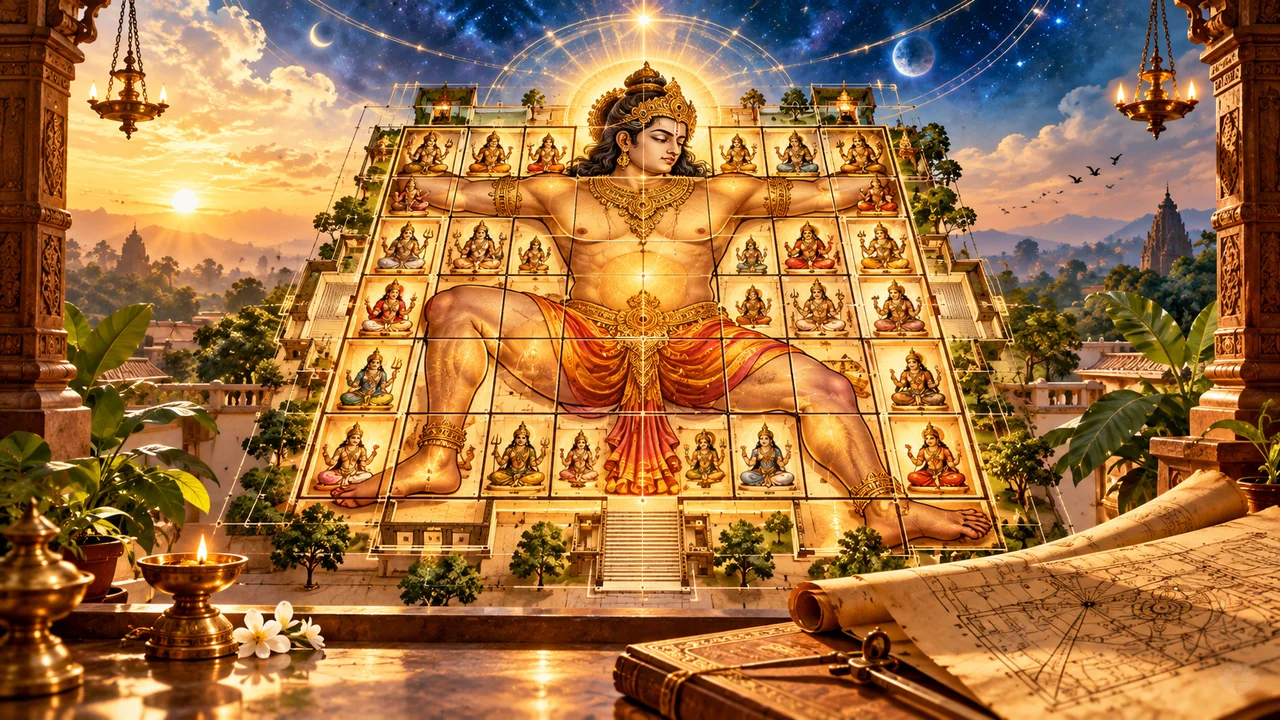
Why do traditional Vastu diagrams depict an enormous human-like figure lying across a square divided into numerous smaller sections?
Why is his head traditionally shown towards the northeast and his feet towards the southwest?
And most importantly, who exactly is this mysterious being known as Vastu Purusha?
To understand these questions, we must travel beyond modern Vastu tips and explore the fascinating world of the Puranas.
Because Vastu Purusha is not simply a decorative diagram. He belongs to an elaborate tradition of sacred architecture, ritual symbolism and cosmic order.
And the story of his origin is extraordinary.
1. The Birth of Vastu Purusha: A Fascinating Story from the Matsya Purana
The Matsya Purana, Chapter 252, preserves an important account of Vastu Purusha.
The narrative takes us to the fierce battle between Bhagwan Shiva and the Asura Andhaka.
During this tremendous conflict, drops of perspiration fell from Bhagwan Shiva’s forehead.
From this perspiration arose a powerful and terrifying being.
His form was immense, his strength extraordinary, and his hunger seemingly insatiable.
The being began consuming whatever came before him.
His appetite was so enormous that he eventually sought to devour the three worlds.
Imagine the scene.
An extraordinary being has emerged during a cosmic conflict. His hunger cannot be satisfied, and his enormous power threatens the stability of creation.
The Devas become concerned.
What happens next is particularly interesting.
According to the Puranic account, the Devas restrain this being and hold him down.
He lies with his face towards the ground, while various divine beings occupy positions upon his body.
The restrained being eventually becomes associated with the sacred arrangement known as the Vastu Purusha Mandala.
The following chapter of the Matsya Purana, Chapter 253, describes the arrangement of the Vastu diagram and the divine positions within it.
This narrative establishes a sacred background for traditional Vastu worship and architectural planning.
But we should ask an important question.
Why would the Puranas connect the construction of a building with such a dramatic cosmic story?
One possible philosophical interpretation is that the story illustrates the transformation of uncontrolled power into an ordered system.
The being who initially represents overwhelming appetite and force becomes incorporated into a sacred arrangement.
His enormous body becomes the symbolic foundation of an architectural mandala.
This interpretation helps us reflect on the story, although it should not be confused with a literal explanation explicitly supplied by the Purana.
2. The Vastu Purusha Mandala: When Architecture Becomes a Sacred Diagram
In traditional Vastu Shastra, the Vastu Purusha Mandala represents an ordered division of space.
A square is divided into smaller squares, commonly called Padas.
Different Vastu traditions and architectural applications employ different arrangements, including mandalas containing 64 or 81 Padas.
These arrangements are associated with specific deities, positions and architectural principles.
The Vastu Purusha is conventionally depicted within this diagram.
His body becomes part of a symbolic relationship between human form, divine presence and architectural space.
The significance of this arrangement is not that an enormous physical being is scientifically proven to exist beneath every house.
Rather, the diagram belongs to the religious and architectural worldview of classical Vastu literature.
It treats space as something that can be measured, organized and ritually sanctified.
And this brings us to a fascinating observation.
The ancient tradition did not view a building merely as an accumulation of bricks and stones. It could also be understood as an ordered space connected with sacred symbolism.
The Vastu Purusha Mandala became one of the important ways of expressing that relationship.
3. Why Is the Head Towards the Northeast?
In the familiar representation of the Vastu Purusha Mandala, the Purusha is shown with his head towards the northeast and his feet towards the southwest.
His body extends diagonally across the diagram.
This arrangement has contributed to the importance assigned to different directions in many Vastu traditions.
The northeast is called Ishanya, a name associated with Ishana, a form of Bhagwan Shiva.
The southwest is known as Nairritya, associated with Nirriti.
Other directions likewise possess traditional divine associations.
However, we should be careful about one common misunderstanding.
People sometimes assume that every Vastu diagram, every architectural treatise and every ritual tradition uses precisely the same arrangement.
That is not necessarily correct.
Different texts describe different mandalas and arrangements depending on the purpose and context.
Therefore, the familiar northeast-to-southwest posture should be understood as a prominent traditional representation rather than the only possible diagram in the entire history of Vastu Shastra.
Now consider the philosophical beauty of this arrangement.
The human body is being used to express the organization of space.
Just as different parts of our body perform different functions, different areas of a building can be assigned different purposes.
This analogy can help us appreciate the mandala, even though it should not be presented as a scientific proof that every direction possesses a particular invisible force.
4. The Deities of the Vastu Mandala: A Divine Assembly
One of the most fascinating aspects of traditional Vastu is the association of different positions with various Devatas.
The Matsya Purana describes divine positions in the Vastu arrangement, while other architectural texts preserve related systems.
In the well-known 45-deity arrangement, various Devatas occupy positions around and within the mandala.
Among the names associated with traditional Vastu diagrams are:
- Brahma
- Ishana
- Agni
- Yama
- Varuna
- Vayu
- Kubera
- Indra
These names are familiar from the broader Hindu religious tradition, although their exact positions and roles must be studied in the context of the particular Vastu diagram being used.
This is where the subject becomes especially interesting.
The Vastu Mandala does not merely divide a square into geometrical compartments.
It creates a symbolic relationship between the architectural plan and a divine order.
The arrangement reminds us that traditional Indian architecture was frequently connected with religion, ritual, cosmology and philosophical thought.
But does this mean that every direction automatically guarantees wealth, health or success?
No.
The existence of a deity’s name in a traditional mandala does not, by itself, establish every modern claim made about that direction.
For example, a modern consultant might declare that placing a particular decorative object in a particular corner will certainly multiply someone’s income.
Before accepting such a claim, we should ask:
Which classical text teaches this? What exactly does the passage say? And is the modern interpretation faithful to its original context?
Respect for scripture should encourage investigation, not blind acceptance.
5. Brahmasthan: The Sacred Centre of the Home
Among the most significant concepts associated with Vastu is the Brahmasthan.
The word combines Brahma with Sthana, meaning place or position.
In traditional Vastu planning, the central region of the mandala holds special importance.
Depending on the particular mandala, the central Padas are associated with Brahma and the sacred organization of the plan.
This is one reason why the centre of a building receives considerable attention in classical architectural discussions.
Interestingly, many traditional Indian houses were constructed around an open courtyard.
Such courtyards could provide natural light, ventilation, circulation and a gathering space for the family.
However, we should not automatically assume that every traditional courtyard was constructed exclusively because of the Brahmasthan principle. Climate, regional architecture, materials and household requirements also influenced design.
Still, there is a beautiful lesson here.
In many homes, the central courtyard was not simply an empty space.
It could become a place where family members gathered, children played, sunlight entered and daily life unfolded.
Today, we often measure the value of a home by how much of its floor area has been filled.
But traditional architecture reminds us that open space can also have value.
Not every corner needs to be occupied by furniture.
Not every available area needs to be converted into storage.
Sometimes, what we leave open contributes as much to a home as what we build.
6. Does Vastu Purusha Actually Live Beneath Our House?
This is perhaps the most important question.
When we read that Vastu Purusha lies beneath a building, should we understand it as a literal physical description?
The story belongs to the Puranic and ritual tradition.
It is not evidence that a gigantic human-shaped organism physically exists beneath the foundations of every building.
The mandala is a sacred representation used within traditional architectural and ritual systems.
Recognizing this distinction does not diminish its religious significance.
Consider the many ways in which Hindu scriptures communicate knowledge.
Sometimes they present direct instructions.
Sometimes they employ philosophical arguments.
Sometimes they use stories, personifications and elaborate symbolic imagery.
A thoughtful student must understand the nature of the passage being studied.
The Vastu Purusha narrative can be appreciated as a sacred story and as a symbolic framework for architectural order without making unsupported scientific claims.
In fact, understanding its context makes the tradition more fascinating.
Because we begin to appreciate how geometry, mythology, ritual and architecture became interconnected.
7. Why Was Vastu Purusha Worshipped Before Construction?
In traditional building practices, the preparation of land and commencement of construction could be accompanied by religious ceremonies.
These included various forms of Vastu worship and ritual offerings, depending on the text, region and tradition.
The Vastu Purusha Mandala provided a framework for associating the building site with divine presence.
Why was this important?
A building represents a major undertaking.
It involves land, resources, labour, planning and the hope of establishing a secure place for future generations.
In a religious society, such an undertaking naturally became associated with prayers for protection, stability and well-being.
We can appreciate this even today.
When a family performs Bhoomi Pujan before constructing a home, the ceremony may express gratitude, reverence and the desire to begin an important undertaking auspiciously.
But there is another responsibility we should never forget.
A ceremony does not eliminate the need for safe construction.
The foundations must be structurally sound.
The building materials must be appropriate.
The electrical systems must be safe.
And the people working on the construction site must be treated fairly.
Prayer and practical responsibility should complement each other, not compete with each other.
8. The Forgotten Lesson of Vastu Purusha
Let us return to the original Puranic story.
A powerful being emerges with an enormous appetite.
His uncontrolled hunger threatens the cosmic order.
The Devas restrain him, and his existence becomes associated with an organized sacred arrangement.
There is a thought-provoking parallel here.
Human beings also possess enormous desires.
We want bigger houses, more possessions, greater luxury and endless comfort.
There is nothing inherently wrong with creating a beautiful and comfortable home.
But what happens when desire becomes uncontrollable?
A house that was meant to provide happiness can become a source of endless comparison.
We purchase furniture to impress visitors.
We renovate rooms merely to compete with neighbours.
We accumulate objects we hardly use.
And sometimes, while decorating the house, we forget the people living inside it.
The Vastu Purusha story offers an opportunity for spiritual reflection.
Just as the overwhelming force in the narrative becomes part of an ordered arrangement, our own desires also need direction and discipline.
This is an interpretive lesson inspired by the story, not a claim that the Matsya Purana explicitly teaches this psychological analogy.
A beautiful home requires good planning. A beautiful life requires mastery over our desires.
9. What Makes a Home Truly Sacred?
Imagine someone who has carefully followed every Vastu recommendation.
The kitchen is in the preferred direction.
The entrance has been measured.
The Brahmasthan has been considered.
Every decorative object has been placed according to a consultant’s advice.
Yet the inhabitants constantly quarrel, insult their elders, mistreat domestic workers and neglect their responsibilities.
Can the arrangement of rooms alone create spiritual harmony?
This question takes us beyond architecture and towards Dharma.
The Srimad Bhagavatam, particularly Skandha 7, Chapter 14, discusses the responsibilities of household life.
It encourages responsible conduct, compassion and consideration for other living beings.
These teachings are about Grihastha Dharma rather than the technical placement of rooms.
Nevertheless, they provide a valuable complement to our understanding of a sacred dwelling.
Because a house is not made spiritually meaningful merely by placing sacred objects inside it.
It is also made meaningful by the conduct of those who live there.
When family members speak respectfully, care for one another, welcome guests, perform Naam Japa, study scriptures and extend compassion towards others, they cultivate a spiritually nourishing environment.
This does not mean that good conduct replaces architectural planning.
It means that architecture and conduct address different dimensions of household life.
Vastu can guide the arrangement of our surroundings. Dharma guides the arrangement of our actions.
Both deserve attention.
10. Vastu Purusha and the Modern Home
Should someone living in a small apartment feel frightened because their floor plan does not perfectly resemble an ancient mandala?
Certainly, fear should not be the starting point.
Classical Vastu texts emerged within particular architectural, cultural and religious settings.
Modern buildings operate under different constraints, including urban density, shared structures, plumbing systems, safety regulations and limited space.
Studying ancient principles can be enriching.
But their application requires an understanding of context.
It is unreasonable to assume that every difficulty in someone’s life originates from the direction of a bathroom, staircase or entrance.
Likewise, it is irresponsible to promise that changing a painting or purchasing a pyramid will guarantee prosperity.
A more thoughtful approach is to understand the historical teachings, examine their relevance and make sensible decisions about the spaces we inhabit.
A clean, safe, well-maintained and thoughtfully organized home has practical value regardless of whether every traditional recommendation can be followed.
And a home in which people practise compassion, gratitude and spiritual discipline can become deeply meaningful even without architectural perfection.
Conclusion: The Cosmic Being and the Human Within
Vastu Purusha is one of the most fascinating figures in the traditional literature of Indian architecture.
His origin is connected with a dramatic Puranic narrative.
His body becomes part of a sacred architectural diagram.
The positions of various Devatas create a symbolic relationship between space and divine order.
And the Vastu Mandala provides a framework through which architecture can be understood as something more than the construction of walls.
But perhaps the greatest lesson we can draw from this tradition is the importance of order.
Order in the way we plan our homes.
Order in the way we use our resources.
Order in the way we fulfil our responsibilities.
And order in the way we direct our desires.
The Vastu Purusha Mandala reminds us of sacred order in architecture. Our daily conduct determines whether we cultivate harmony within that architecture.
A house may be constructed with bricks, stones, wood and concrete.
But a sacred home is also shaped by love, compassion, gratitude, discipline and devotion.
And that is a beautiful thought to carry with us whenever we enter our homes.
Sambhasha | Divine Dialogues
Scriptural References and Further Reading
- Matsya Purana, Chapter 252: Traditional account of the origin of Vastu Purusha and the teachers of Vastu Shastra.
- Matsya Purana, Chapter 253: Preparation of the Vastu Mandala and associated divine positions.
- Mayamatam: Classical Sanskrit architectural treatise discussing Vastu, site planning, measurements, orientation and buildings.
- Brihat Samhita, Chapter 53: Varahamihira’s discussion of Vastu Vidya and house-building.
- Srimad Bhagavatam, Skandha 7, Chapter 14: Responsibilities and ethical conduct of householders.
Note: The descriptions of Puranic events reflect traditional religious narratives. Philosophical interpretations and modern practical observations have been distinguished from direct scriptural teachings.