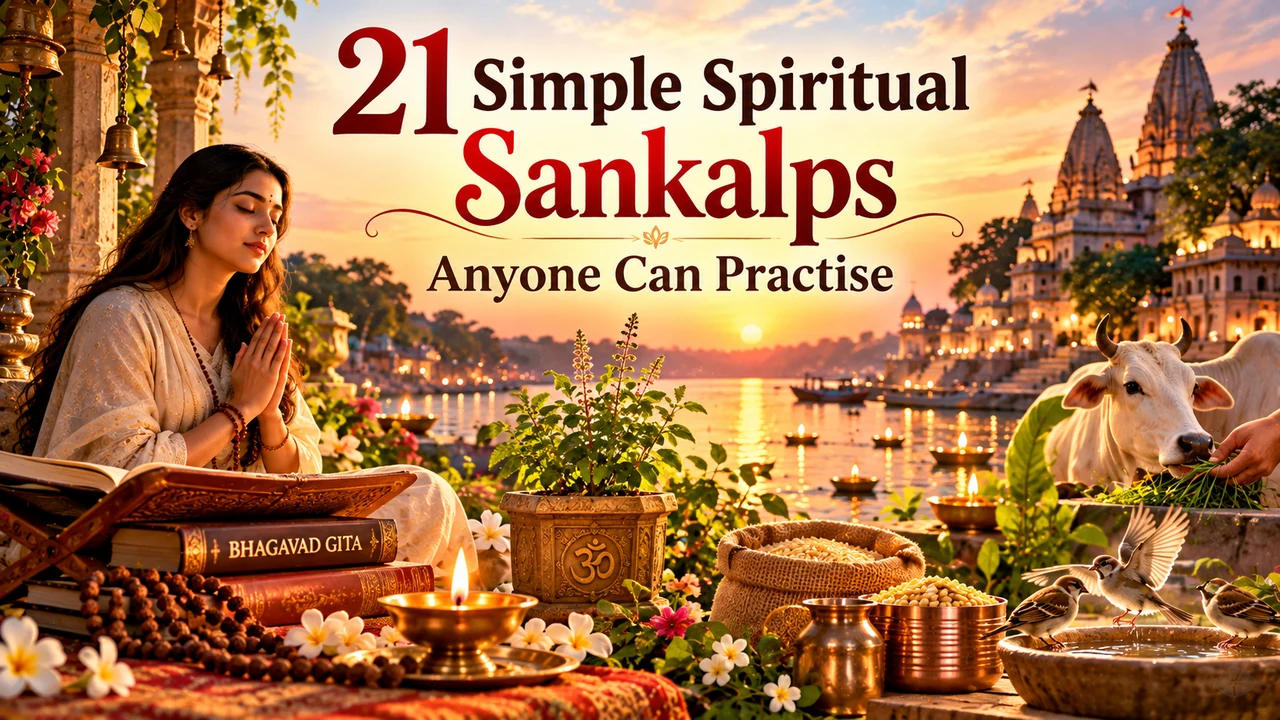
One small spiritual commitment every week can become the beginning of a beautiful journey towards Bhagwan.
Spiritual Growth Begins with One Small Commitment
We often wish to become more spiritual. We want to chant Bhagwan’s names, meditate regularly, help others, read sacred scriptures and develop better habits.
Yet, despite our good intentions, everyday responsibilities frequently prevent us from taking the first step.
What if spiritual growth did not require changing our entire lifestyle overnight?
What if we could begin with just one small commitment every week?
This is the philosophy behind the Sankalp Movement, an initiative encouraging individuals to introduce meaningful spiritual practices into their everyday lives.
हर सप्ताह एक छोटा आध्यात्मिक संकल्प।
One small spiritual commitment every week.
A Sankalp is a conscious resolution undertaken with sincerity and determination. In spiritual life, it becomes a way of transforming our intentions into meaningful actions.
The purpose is not to undertake extraordinary austerities but to gradually cultivate devotion, compassion, self-discipline and divine remembrance.
What Does the Bhagavad Gita Teach About Small Efforts?
In Bhagavad Gita 2.40, Shri Krishna declares:
नेहाभिक्रमनाशोऽस्ति प्रत्यवायो न विद्यते ।
स्वल्पमप्यस्य धर्मस्य त्रायते महतो भयात् ॥
Meaning: On this spiritual path, no effort is lost, nor does it produce an adverse result. Even a little practice of this Dharma protects one from great fear.
This beautiful teaching reminds us that sincere spiritual efforts have value, even when they appear small.
We do not have to wait until we possess unlimited time or perfect discipline before beginning our Sadhana.
A few minutes of divine remembrance, a thoughtful act of Seva or a small charitable offering can become the beginning of a more spiritually conscious life.
With this inspiration, here are 21 simple spiritual Sankalps that anyone can consider practising.
21 Spiritual Sankalps for Everyday Life
Naam Japa and Devotion
1. Ram Naam Japa
Begin with a Sankalp of chanting Shri Ram’s divine name 10,000 times in one week. Divide the repetitions across seven days according to your convenience.
2. Radha Naam Japa
Chant Shri Radha’s divine name 10,000 times during the week, cultivating love, devotion and remembrance.
3. Shiva Naam Japa
Undertake a weekly Sankalp of 5,000 repetitions of Om Namah Shivaya, according to your spiritual tradition and personal practice.
4. Gayatri Mantra Japa
Chant the Gayatri Mantra 108 times during the week, following the guidance and customs of your spiritual tradition.
Naam Japa occupies a special place in Hindu devotional literature. The Srimad Bhagavatam (12.3.51) glorifies the chanting of Shri Krishna’s divine name as an especially significant spiritual practice in Kali Yuga.
Starting Small and Gradually Increasing Naam Japa
For beginners, the Sankalp Movement encourages starting with 10,000 Naam Japa per week, whether chanting Ram, Radha, Krishna, Shiva or another chosen divine name.
Once this practice becomes comfortable and consistent, participants may gradually increase their weekly targets.
The aim is not to compete or rush towards enormous numbers. It is to establish regular divine remembrance and allow the practice to deepen naturally.
Puja and Scriptural Study
5. Tulsi Deep Daan
Light a diya near Tulsi Mata for seven days, with devotion and gratitude. Place it safely and never leave an open flame unattended.
6. Bhagavad Gita Path
Read five shlokas of the Bhagavad Gita every day, along with their meanings. Reflect on how Shri Krishna’s teachings can be applied to daily life.
7. Stotra Path
Recite the Hanuman Chalisa, Vishnu Sahasranama or another favourite stotra regularly during the week.
The Bhagavad Gita (16.1) includes Svadhyaya, the study or recitation of sacred teachings, among the divine qualities. Scriptural study can help us bring greater understanding into our spiritual practices.
Daan and Seva
8. Ann Daan
Donate atta, rice, pulses or other essential food items to a family or person in need.
9. Gau Seva
Contribute fodder, food or other useful supplies to a responsibly managed Gaushala.
10. Pakshi Seva
Arrange clean drinking water and appropriate food for birds, ensuring that feeding practices are safe for the animals and the local environment.
11. Jal Seva
Provide safe drinking water to people in need, especially during hot weather.
12. Nishkama Seva
Help someone without expecting recognition, appreciation or any personal reward.
In Bhagavad Gita 3.9, Shri Krishna teaches the importance of performing actions in the spirit of Yajna rather than merely for selfish purposes.
Through Yajna Bhava, even ordinary actions can become sacred offerings when performed with the right intention.
A small act of service, undertaken with compassion and dedicated to Bhagwan, can become a meaningful form of Sadhana.
Meditation and Inner Discipline
13. Dhyana Sankalp
Meditate for ten minutes every day. Begin with a comfortable posture and gently bring your attention back whenever the mind wanders.
14. Maun Sadhana
Practise ten minutes of mindful silence daily, reducing unnecessary speech and distractions.
15. Krodha Niyantran
For seven days, consciously work towards controlling anger. Before reacting, pause and respond with greater awareness.
16. Madhur Vani Sankalp
Avoid harsh words, insults, gossip and unnecessary criticism for seven days.
17. Satya Sankalp
Make a sincere effort to practise truthfulness in your speech and actions throughout the week.
Maharishi Patanjali, in the Yoga Sutras (2.30), identifies Ahimsa, Satya and other ethical disciplines as essential components of the spiritual path.
Similarly, the Bhagavad Gita (17.15) praises speech that is truthful, beneficial and does not unnecessarily disturb others.
These teachings remind us that spirituality is not limited to what we practise during Puja. It should also influence our behaviour and relationships.
Compassion, Relationships and Gratitude
18. Ahimsa Sankalp
For seven days, make a conscious effort to avoid causing unnecessary harm to living beings through your actions or words.
19. Mata-Pita and Elder Seva
Perform a thoughtful act of service for your parents, grandparents or another elderly person who could benefit from your care.
20. Kshama Sankalp
Reflect on resentment you may be carrying and make a sincere effort towards forgiveness, without compromising personal safety or healthy boundaries.
21. Kritagyata Sankalp
Every night, remember five blessings in your life and express gratitude to Bhagwan.
These Sankalps encourage us to cultivate qualities that extend beyond formal religious practices.
Compassion, gratitude, truthfulness, patience and respect are important expressions of spiritual maturity.
How to Participate in the Sankalp Movement
The idea is simple.
Choose one spiritual Sankalp every week, according to your interests, circumstances and abilities.
Some weeks may be dedicated to Naam Japa, while others may focus on Seva, Daan, meditation, scriptural study or self-discipline.
You may also continue a previous Sankalp while gradually introducing new practices.
For example, someone who begins with 10,000 Naam Japa per week may maintain that commitment for several weeks before increasing the target.
The purpose is to develop a sustainable spiritual routine rather than create unnecessary pressure.
And if an unexpected situation prevents you from completing a commitment, you can renew your Sankalp and continue with sincerity.
Every Sankalp Can Become an Offering to Bhagwan
One of the most beautiful teachings of the Bhagavad Gita appears in Chapter 9, Verse 27.
यत्करोषि यदश्नासि यज्जुहोषि ददासि यत् ।
यत्तपस्यसि कौन्तेय तत्कुरुष्व मदर्पणम् ॥
Meaning: Whatever you do, whatever you eat, whatever you offer in sacrifice, whatever you give away and whatever austerity you practise, O Arjuna, do that as an offering to Me.
This verse beautifully captures the spirit of the Sankalp Movement.
Naam Japa can become an offering of our time and attention.
Ann Daan can become an offering of compassion.
Meditation can become an offering of our awareness.
And the effort to improve our conduct can become an offering of self-discipline.
What matters is not merely completing a task but cultivating the right intention behind it.
One Small Sankalp, A Lifelong Spiritual Journey
Spiritual transformation does not always arrive through dramatic experiences or extraordinary achievements.
Sometimes, it begins quietly.
With one divine name.
One act of kindness.
One moment of silence.
One sincere resolution to become a better human being.
Through the Sankalp Movement, we invite everyone to take these small but meaningful steps towards a more devotional, compassionate and spiritually conscious life.
You do not have to accomplish everything today. Simply begin with one Sankalp, practise it sincerely and allow your spiritual journey to unfold.
One week. One small Sankalp. One more step towards the Divine.
Sambhasha | Divine Dialogues
Scriptural References
- Bhagavad Gita 2.40: The enduring value of spiritual effort.
- Srimad Bhagavatam 12.3.51: The glory of Krishna Kirtan in Kali Yuga.
- Bhagavad Gita 3.9: Yajna Bhava and freedom from selfish attachment.
- Bhagavad Gita 9.27: Offering one’s actions to Bhagwan.
- Bhagavad Gita 16.1: Svadhyaya and other divine qualities.
- Bhagavad Gita 17.15: Truthful, beneficial and considerate speech.
- Yoga Sutras 2.30: Ahimsa, Satya and other ethical disciplines.
Note: The specific weekly targets, including 10,000 Naam Japa, are suggested practices of the Sankalp Movement. They are not numerical requirements prescribed by the cited scriptures.