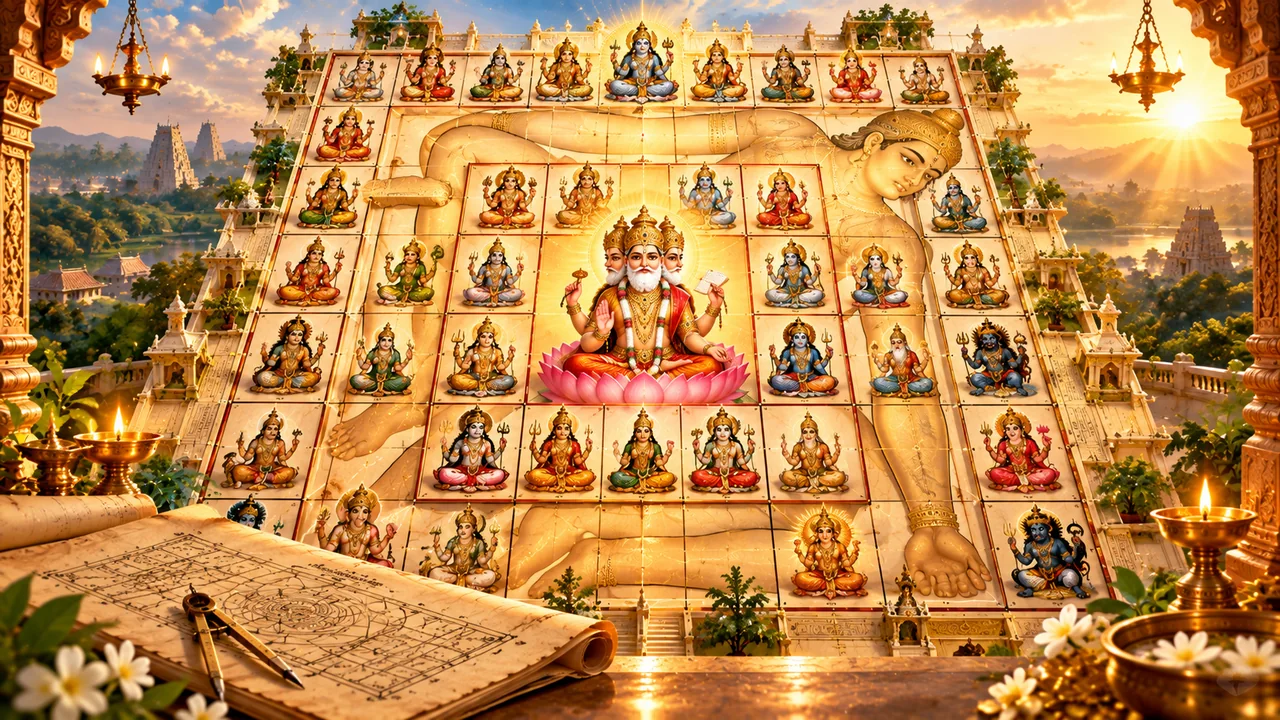
Discovering the Divine Guardians of the Vastu Purusha Mandala and the forgotten spiritual wisdom of sacred architecture.
Sambhasha: Divine Dialogues
1. Is Your Home Really Connected to 45 Devatas?
Imagine looking at the architectural plan of your home.
You see the bedrooms, kitchen, living room, bathrooms and entrances. For most of us, it is simply a drawing showing how different spaces have been arranged.
But imagine an ancient Vastu Acharya examining the same piece of land.
Instead of seeing only walls and rooms, he might begin by dividing the site into a sacred geometrical arrangement known as the Vastu Purusha Mandala.
And within this mandala, he would identify the positions of various Devatas.
Not five, not eight, but 45 Devatas in one important traditional system.
Why were so many divine beings associated with a single architectural plan?
Were these Devatas considered guardians of different portions of space?
What is the relationship between Bhagwan Brahma, the Vastu Purusha and the various directional deities?
And does the presence of these names mean that every modern Vastu prediction is supported by scripture?
To understand these fascinating questions, we must turn towards the Matsya Purana and the Brihat Samhita.
2. The Matsya Purana Reveals the Number 45
One of the clearest scriptural references appears in Matsya Purana, Chapter 253.
The text describes the preparation of a Vastu Mandala consisting of 81 Padas, or divisions.
It then explains that 45 Devatas are to be worshipped within this arrangement.
The division is particularly interesting:
32 Devatas occupy the outer arrangement, while 13 Devatas occupy the inner arrangement.
This is not simply a modern numerical theory invented by Vastu consultants. It is described in the Puranic text itself.
The Matsya Purana then proceeds to identify the Devatas and their respective positions.
A closely related arrangement also appears in Varahamihira’s Brihat Samhita, Chapter 53, which discusses Vastu Vidya.
Here we discover an important aspect of traditional Indian knowledge.
Architecture was not understood merely through physical measurements. Its ritual and symbolic systems also connected the building site with the divine world.
However, the number 45 refers to a particular mandala arrangement. Other traditional Vastu diagrams employ different divisions and configurations.
Therefore, it would be incorrect to assume that every architectural diagram in every Vastu text contains exactly the same arrangement.
3. The 32 Outer Devatas: Guardians of the Sacred Perimeter
The Matsya Purana names 32 Devatas associated with the outer arrangement of the mandala.
Beginning from the northeast and proceeding around the perimeter, the traditional list includes:
शिखी, पर्जन्य, जयन्त, इन्द्र, सूर्य, सत्य, भृश, अन्तरिक्ष, वायु, पूषा, वितथ, बृहत्क्षत, यम, गन्धर्व, भृङ्गराज, मृग, पितृ, दौवारिक, सुग्रीव, पुष्पदन्त, जलाधिप, असुर, शोष, पाप, रोग, अहि, मुख्य, भल्लाट, सोम, सर्प, अदिति, दिति।
Some manuscript traditions and editions employ variant names or synonyms.
For example, we encounter names such as Pushpadanta and Kusumadanta, Jaladhipa and Ambupati, or Antariksha and Akasha.
What is especially fascinating is the variety of divine and symbolic names within this list.
We encounter familiar figures such as Surya, Indra, Yama and Soma.
We also encounter names such as Parjanya, associated with rain, and Aditi, a prominent Vedic divine figure.
Then there are less familiar names, including Vitatha, Bhallata and Dauvārika.
Some names, such as Roga and Papa, may initially surprise readers.
Why would an auspicious architectural arrangement contain names associated with disease or wrongdoing?
Because a traditional sacred diagram is not necessarily a collection of only pleasant or wealth-giving powers.
It can represent a much broader cosmological and ritual order, including forces and conditions that human beings seek to understand, regulate or overcome.
This is one reason why reducing every Vastu Devata to a promise of money or prosperity can be misleading.
The traditional mandala is considerably more complex.
4. The 13 Inner Devatas: The Sacred Interior
The inner arrangement contains 13 Devatas.
These include Brahma at the centre, eight Devatas surrounding Brahma, and four associated with the intermediate inner positions.
The eight surrounding Brahma are traditionally named:
अर्यमा, सविता, विवस्वान्, विबुधाधिप, मित्र, राजयक्ष्मा, पृथ्वीधर, आपवत्स।
The four additional inner Devatas are:
आप, सावित्र, जय और रुद्र।
Together with Brahma, these form the 13 inner Devatas.
The arrangement creates an interesting distinction between the outer and inner portions of the mandala.
The outer Devatas establish a sacred perimeter.
The inner Devatas form a more concentrated arrangement surrounding the central position of Brahma.
We should not imagine that this necessarily means 45 physical beings are literally seated beneath the floor of every modern apartment.
The mandala is a traditional sacred and architectural representation, and the Devatas belong to its religious and ritual framework.
Understanding this distinction allows us to appreciate the tradition without making unsupported physical claims.
5. Why Does Brahma Occupy the Centre?
Among all the Devatas associated with the Vastu Mandala, Brahma occupies a particularly significant position.
In the 81-Pada arrangement described by Varahamihira, the central nine squares are associated with Brahma.
This central region is connected with the concept commonly known as Brahmasthan.
But why should the centre receive such importance?
From an architectural perspective, the centre is a fundamental reference point in the organization of a plan.
From a religious perspective, the association with Brahma introduces a sacred dimension.
And from a philosophical perspective, the central position can inspire reflection on the relationship between order and balance.
Consider the traditional Indian courtyard house.
The centre was sometimes left open, allowing sunlight, fresh air and family activity to occupy the heart of the dwelling.
It would be inaccurate to claim that every historical courtyard was built exclusively because of the Brahmasthan principle. Climate, materials, culture and practical requirements also shaped traditional architecture.
Nevertheless, the comparison is meaningful.
Sometimes the most valuable part of a house is not what we place inside it, but the space we thoughtfully preserve.
An empty space is not necessarily a wasted space.
6. The Devatas and the Human Body: A Remarkable Connection
There is another fascinating dimension to this subject.
The Brihat Samhita does not merely list the Devatas of the mandala.
It also associates various Devatas with different parts of the Vastu Purusha’s body.
The text describes relationships involving the eyes, ears, arms, thighs and other bodily regions.
Brahma is associated with the heart of the Vastu Purusha.
This creates a striking symbolic connection between the human body and architectural space.
Why would ancient authors use the human form to explain the arrangement of a building?
One possible philosophical interpretation is that the body provides an understandable model of an organized whole.
Different parts of the body have different roles, yet they function together.
Similarly, a building contains different spaces serving different purposes.
The analogy is beautiful, but we must distinguish interpretation from textual fact.
The classical text describes the divine and bodily associations. The broader philosophical meaning we draw from those associations is an interpretive reflection.
It should not be presented as a scientific demonstration that a building possesses human anatomy.
7. The Eight Dikpalas and the 45 Vastu Devatas: Are They the Same?
This is a very common confusion.
Many people are familiar with the eight directional guardians, or Ashta Dikpalas.
A commonly used traditional list includes:
Indra in the east, Agni in the southeast, Yama in the south, Nirriti in the southwest, Varuna in the west, Vayu in the northwest, Kubera in the north and Ishana in the northeast.
But these eight directional guardians should not be confused with the complete 45-Devata Vastu Mandala.
The two systems are related through the broader tradition of sacred directions, yet they are not identical lists.
For example, Kubera is widely associated with the northern direction in the Dikpala tradition, but he is not simply one of the 32 outer Devatas under that name in the classical list presented above.
Likewise, the positions and names in the Vastu Mandala follow their own textual arrangement.
This distinction matters because modern Vastu explanations frequently combine different traditional systems without identifying their sources.
A responsible study should ask which particular scripture, mandala and arrangement is being discussed.
8. Do These 45 Devatas Control Our Wealth, Health and Destiny?
Today, we frequently encounter statements such as:
A particular Devata controls your bank balance.
Another Devata determines whether your relationships will succeed.
A third Devata guarantees fame or professional success.
And if a certain object is placed in the wrong position, an entire aspect of your life will supposedly collapse.
But we must ask a simple question.
Where exactly is this written?
The Matsya Purana and Brihat Samhita describe divine positions, architectural arrangements and ritual considerations.
They do not automatically validate every modern psychological, financial or medical claim attributed to the 45 Devatas.
Different Vastu traditions may contain additional interpretations and prescriptions, but these require individual textual examination.
We should never assume that a modern interpretation becomes scriptural merely because it uses a Sanskrit name.
There is a difference between studying a traditional system and exaggerating its claims.
And this distinction becomes particularly important when people are frightened into purchasing expensive remedies.
9. The Deeper Spiritual Message of the Vastu Mandala
There is a beautiful idea that emerges when we consider the complete arrangement.
The Vastu Mandala brings numerous divine names into a single organized structure.
Each has a designated position.
The arrangement forms a unified whole.
This can inspire a philosophical reflection about cooperation and interdependence.
Just as different parts of a building contribute to its overall functioning, different members of a household contribute to the life within it.
Parents, children, elders and other family members may have different responsibilities, but harmony requires mutual consideration.
A beautiful house is not created merely by purchasing expensive furniture.
And a harmonious home cannot be created merely by rearranging decorative objects.
It also requires respect, kindness, honesty and a willingness to fulfil our responsibilities.
This is a spiritual reflection inspired by the mandala, rather than a direct translation of a Vastu verse.
It reminds us that the arrangement of our surroundings and the quality of our conduct are two different, but complementary, concerns.
10. Rediscovering the Sacred Meaning of Space
The 45 Devatas of Vastu reveal an extraordinary dimension of traditional Indian architecture.
A piece of land could be transformed into a sacred geometrical arrangement.
The outer and inner portions were associated with different Devatas.
Brahma occupied the central region.
And the Vastu Purusha provided a symbolic human form through which the arrangement could be understood.
This is a rich combination of geometry, religious imagination, ritual and architectural knowledge.
But perhaps the most important lesson is that ancient traditions deserve careful study.
We should neither dismiss them without understanding their historical context nor accept every modern claim made in their name.
We should return to the original scriptures, examine the terminology, compare the traditions and distinguish textual teachings from later interpretations.
The real beauty of Vastu Shastra lies not in frightening people about the corners of their homes, but in discovering the remarkable ways ancient India understood and organized sacred space.
A building can be carefully designed.
A sacred space can be ritually honoured.
But a truly harmonious home also requires the people living inside it to practise compassion, responsibility and Dharma.
That is where architectural wisdom and spiritual living can meet.
Sambhasha | Divine Dialogues
Scriptural References
- Matsya Purana, Chapter 253, verses 21–33: The 81-Pada Vastu Mandala, the 45 Devatas, their names, positions and arrangements.
- Brihat Samhita, Chapter 53, verses 42–48: Varahamihira’s description of the 81-square architectural diagram and the outer and inner Devatas.
- Brihat Samhita, Chapter 53, verses 52–54: Associations between the Devatas and different parts of the Vastu Purusha’s body.
- Brihat Samhita, Chapter 53, verses 55–56: An alternative 64-square arrangement, demonstrating that classical Vastu employs more than one mandala system.
- Matsya Purana, Chapter 252: The traditional account of Vastu Purusha and the teachers of Vastu Shastra.
Editorial note: Sanskrit names sometimes differ across manuscripts, editions and translations. The names above follow the Matsya Purana and Brihat Samhita traditions; differences in nomenclature should not be mistaken for entirely different deities without examining the relevant passages.