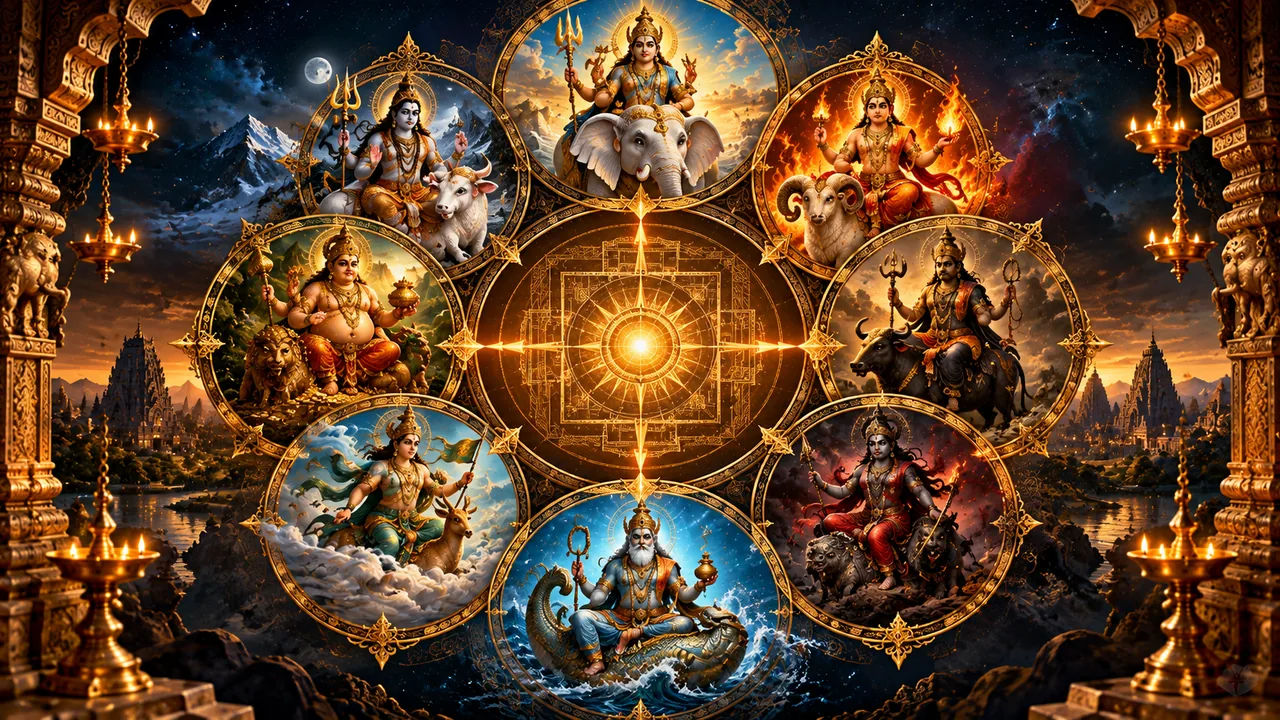
The Eight Dikpalas: Divine Guardians of the Eight Directions
Discover the fascinating world of the Ashta Dikpalas, the celestial guardians who connect Hindu cosmology, ancient temples, sacred architecture and Vastu Shastra.
Sambhasha: Divine Dialogues
1. Who Guards the Eight Directions of the Universe?
Imagine standing in the courtyard of an ancient Hindu temple.
The rising Sun illuminates the eastern entrance. A gentle breeze moves through the pillars. The temple walls are decorated with magnificent sculptures of divine beings, each carrying distinctive weapons and accompanied by extraordinary animals.
At first glance, these sculptures might appear to be purely decorative.
But what if their positions were deliberately chosen?
What if the deity carved on the eastern wall represented the guardian of the east, while another deity on the western side represented the guardian of the west?
This brings us to one of the most fascinating concepts in traditional Hindu cosmology and sacred architecture: the Ashta Dikpalas, or the Eight Guardians of the Directions.
The Sanskrit word Dik (दिक्) means direction, while Pala (पाल) means protector or guardian.
Thus, Dikpalas are the divine guardians associated with the different directions of space.
In a widely recognized Hindu tradition, eight principal directions are associated with eight Devatas.
These divine beings are not merely characters in mythology. Their identities appear in religious literature, ritual traditions, temple sculptures and architectural symbolism.
And their study opens a remarkable window into the ancient Indian understanding of the universe.
2. Why Did Ancient India Associate Directions With Devatas?
Today, when we think of directions, we generally think of a compass.
North, south, east and west help us navigate roads, locate places and orient buildings.
But in traditional Indian religious thought, directions could carry meanings beyond geographical orientation.
They could also be associated with divine guardianship and cosmic order.
The east, where the Sun rises, became associated with Indra in the familiar Dikpala system.
The southeast became associated with Agni, the deity of fire.
The south was associated with Yama, the lord of death and Dharma.
And the northeast became associated with Ishana, a form of Bhagwan Shiva.
These associations formed a sacred map of space.
However, we must remember that Hindu religious traditions developed over long periods and across different regions.
Not every early text presents precisely the same eightfold arrangement.
Some traditions emphasize four principal guardians, while others describe eight or even ten directional guardians.
The familiar eightfold system is especially prominent in later religious art, temple architecture and ritual practice.
3. The Eight Dikpalas and Their Directions
The commonly recognized arrangement is as follows:
| Direction | Sanskrit Name | Guardian |
|---|---|---|
| East | पूर्व (Purva) | Indra |
| Southeast | आग्नेय (Agneya) | Agni |
| South | दक्षिण (Dakshina) | Yama |
| Southwest | नैऋत्य (Nairritya) | Nirriti |
| West | पश्चिम (Pashchima) | Varuna |
| Northwest | वायव्य (Vayavya) | Vayu |
| North | उत्तर (Uttara) | Kubera |
| Northeast | ईशान (Ishanya) | Ishana |
What makes this arrangement particularly interesting is that the names of several directions themselves preserve the association with their traditional guardians.
Agneya is connected with Agni.
Nairritya is connected with Nirriti.
Vayavya is connected with Vayu.
And Ishanya is connected with Ishana.
The very language of directions therefore preserves an important part of Hindu religious heritage.
Let us now explore each of these eight extraordinary Devatas.
4. Indra: The Guardian of the East
Direction: East (Purva)
Traditional Vahana: Airavata, the elephant
Principal Symbol: Vajra
Indra is one of the most prominent Devatas of the Rigveda.
He is celebrated for his strength, his association with storms and rain, and his victory over Vritra.
In the famous Vedic narrative, Indra defeats Vritra, who had obstructed the waters.
The release of the waters becomes an important theme in Vedic poetry.
Indra is also known as the wielder of the Vajra, his powerful thunderbolt.
In the traditional Dikpala arrangement, he guards the eastern direction.
This association is especially interesting because the east is the direction of sunrise.
It marks the beginning of the visible day and is naturally connected with light and renewal.
We may reflect upon Indra’s position as a symbol of leadership, protection and the overcoming of obstacles.
However, these philosophical associations should not be mistaken for a claim that every modern Vastu prescription concerning the east appears directly in the Rigveda.
Scriptural reference: Rigveda 1.32, the hymn celebrating Indra’s victory over Vritra.
5. Agni: The Guardian of the Southeast
Direction: Southeast (Agneya)
Traditional Vahana: Ram
Principal Symbol: Fire
Agni holds an extraordinarily important position in Vedic religion.
The very first hymn of the Rigveda begins with an invocation to Agni.
अग्निमीळे पुरोहितं यज्ञस्य देवमृत्विजम्।
I praise Agni, the divine priest of the sacrifice.
Rigveda 1.1.1, opening portion.
Agni is closely associated with Yajna, sacrificial offerings and the connection between human worship and the Devatas.
In the Dikpala arrangement, Agni presides over the southeast.
The name Agneya itself reflects this association.
This is also why the southeast is frequently discussed in traditional Vastu explanations concerning the placement of fire-related activities.
But an important distinction must be maintained.
The fact that Agni is the guardian of the southeast does not automatically prove every modern claim concerning electrical appliances, electronic gadgets or kitchen arrangements.
Those specific prescriptions must be examined separately in their relevant architectural texts.
The deeper religious significance of Agni lies in his relationship with sacred offerings, transformation and the ritual life of the Vedic tradition.
6. Yama: The Guardian of the South
Direction: South (Dakshina)
Traditional Vahana: Buffalo
Principal Symbols: Danda and Pasha
Yama is widely known as the lord associated with death, the departed and the moral consequences of human actions.
In Vedic literature, Yama is connected with the realm of the ancestors.
In later Hindu traditions, he is also closely associated with Dharma and the judgment of deeds.
His appearance in the Katha Upanishad is particularly fascinating.
There, the young Nachiketa approaches Yama and asks profound questions about death, the Self and what lies beyond bodily existence.
Instead of presenting Yama merely as a terrifying deity, the Upanishad portrays him as a teacher of spiritual knowledge.
This is a beautiful reminder that Hindu scriptures often present divine figures with multiple dimensions.
In the traditional Dikpala system, Yama guards the southern direction.
Unfortunately, this association has sometimes led to the simplistic claim that every south-facing house is necessarily inauspicious.
Such a conclusion cannot be established merely from Yama’s directional guardianship.
A deity’s association with a direction and the architectural suitability of a particular building are separate questions.
Scriptural references: Rigveda 10.14 and Katha Upanishad, especially its dialogue between Nachiketa and Yama.
7. Nirriti: The Mysterious Guardian of the Southwest
Direction: Southwest (Nairritya)
Traditional Identity: Nirriti or Nairrita
Iconography: Varies across traditions
Among the eight Dikpalas, Nirriti is perhaps one of the most mysterious.
The name Nirriti appears in Vedic literature in contexts associated with misfortune, destruction and dissolution.
In later traditions, Nirriti or Nairrita becomes associated with the southwestern direction.
Unlike some other Dikpalas, whose iconography is relatively familiar, Nirriti’s form and vehicle vary considerably across textual and artistic traditions.
This makes the deity particularly interesting for students of Hindu iconography.
But there is an important philosophical point.
Ancient religious traditions did not recognize only pleasant aspects of existence.
They also acknowledged destruction, mortality, disorder and suffering.
These realities were incorporated into broader religious and cosmological systems.
The association of Nirriti with the southwest should therefore be studied within its historical and ritual context.
It should not be used to frighten householders into believing that a minor architectural irregularity will inevitably cause tragedy.
8. Varuna: The Guardian of the West
Direction: West (Pashchima)
Traditional Vahana: Makara
Principal Symbol: Pasha
Varuna is one of the most profound divine figures of Vedic literature.
In the Rigveda, he is closely associated with Rita, the cosmic order that sustains the universe.
His hymns frequently emphasize moral order, truth and the consequences of wrongdoing.
This makes Varuna far more than a simple deity of water.
Although later traditions strongly associate him with oceans and aquatic symbolism, his Vedic character possesses a remarkable ethical dimension.
In traditional iconography, Varuna is often depicted holding a Pasha, or noose, and riding a Makara, a mythological aquatic creature.
He guards the western direction.
The association with water has encouraged numerous modern Vastu interpretations concerning the west.
However, it is important not to confuse Varuna’s mythological attributes with independently verified architectural or scientific principles.
Scriptural reference: Rigveda 7.86, a celebrated hymn addressed to Varuna that reflects upon wrongdoing, forgiveness and divine order.
9. Vayu: The Guardian of the Northwest
Direction: Northwest (Vayavya)
Traditional Vahana: Deer or Antelope
Principal Association: Wind
Vayu is the deity associated with wind.
In Vedic literature, Vayu appears as a divine presence connected with the movement of air.
The name Vayavya, referring to the northwest, directly reflects this association.
In traditional Hindu iconography, Vayu is sometimes depicted riding a deer or antelope.
The imagery beautifully conveys movement and swiftness.
Air is essential to life, and wind is one of the most immediately perceptible forces of nature.
We cannot ordinarily see the wind itself, but we can observe its effects.
Leaves move, clouds travel and the atmosphere changes.
It is easy to appreciate why ancient religious imagination gave wind a divine personality.
From a practical architectural perspective, ventilation and local wind patterns certainly matter.
However, these must be evaluated according to climate, geography and building design rather than assuming that one compass direction always behaves identically everywhere.
Scriptural reference: Rigveda 1.134, a hymn addressed to Vayu.
10. Kubera: The Guardian of the North
Direction: North (Uttara)
Traditional Association: Wealth and Treasures
Iconography: A wealthy divine king, often with a money bag or other symbols of abundance
Kubera is among the most recognizable figures in popular discussions of Vastu Shastra.
He is widely known as the lord of wealth and treasures.
In Hindu religious literature, Kubera is associated with the Yakshas and with the northern region.
He is also connected with Alaka, his magnificent celestial city.
Kubera appears in various Sanskrit literary and religious traditions, including the Ramayana and later Puranic literature.
His directional association is one reason the north has become particularly prominent in modern Vastu discussions about financial prosperity.
But we should ask an important question.
Does Kubera’s guardianship of the north mean that every north-facing entrance guarantees wealth?
Certainly not.
Mythological association is not the same as a guarantee of financial success.
The traditional symbolism of Kubera can remind us of abundance and the responsible stewardship of resources.
But genuine financial well-being also depends upon work, judgment, ethical conduct, planning and circumstances.
Kubera’s place in the Dikpala system is fascinating enough without turning it into an unsupported promise of instant prosperity.
11. Ishana: The Guardian of the Northeast
Direction: Northeast (Ishanya)
Divine Identity: Ishana, a form of Bhagwan Shiva
Traditional Symbols: Shaiva attributes
Among all eight directions, the northeast receives exceptional attention in many modern Vastu discussions.
It is known as Ishanya, a name connected with Ishana.
Ishana is an important name and aspect of Bhagwan Shiva.
The term also appears in Shaiva theological traditions, including discussions of the different faces and manifestations of Shiva.
The northeast’s association with Ishana gives it a particularly sacred identity within the directional system.
This is one reason the region is frequently discussed in connection with worship and religious activity.
However, we should avoid the simplistic conclusion that every modern rule about the northeast has an identical origin in ancient scripture.
The significance of Ishana as a divine guardian is well established in traditional iconography.
Specific architectural prescriptions require separate examination of the relevant Vastu treatises.
The spiritual significance of Ishana can inspire contemplation of knowledge, devotion and the divine presence that transcends the physical world.
12. The Dikpalas in Hindu Temple Architecture
Now that we understand the eight guardians, let us return to the ancient temple courtyard.
Why were these deities carved on temple walls, pillars and ceilings?
In traditional Indian temple architecture, divine imagery was often arranged according to carefully developed iconographic systems.
The Dikpalas became an important part of these arrangements.
Their images could appear around the temple structure, sometimes corresponding to the directions they guarded.
Each deity was identified through distinctive attributes, vehicles and iconographic features.
Indra might be recognized by his elephant and Vajra.
Agni by his fiery attributes and ram.
Yama by his buffalo.
Varuna by his Makara and Pasha.
These images were not merely decorative.
They expressed a religious vision in which sacred architecture was connected with an ordered universe.
The temple could thus be understood as a sacred centre surrounded by divine guardianship.
This is one reason why studying temple sculptures requires more than simply identifying which deity is represented.
We must also ask why the deity occupies that particular location.
13. Eight Dikpalas, Ten Dikpalas and the 45 Vastu Devatas
A fascinating complication arises when we compare different religious and architectural traditions.
Sometimes we encounter eight Dikpalas.
Sometimes we encounter ten.
And in the Vastu Purusha Mandala, we encounter the famous arrangement of 45 Devatas.
Are these contradictory systems?
Not necessarily.
They represent different ways of organizing sacred space.
The eightfold system recognizes the four principal directions and four intermediate directions.
The tenfold system additionally recognizes the upward and downward directions.
The identities of the two additional guardians can differ across traditions.
Meanwhile, the 45-Devata Vastu Mandala represents a more elaborate arrangement of divine positions within an architectural grid.
The 45 Devatas should therefore not be understood as merely the eight Dikpalas multiplied into a larger list.
The systems are related, but their structures and purposes differ.
This distinction is particularly important for anyone studying Vastu Shastra through original Sanskrit texts.
14. What Do the Ancient Scriptures Actually Teach?
When researching the Dikpalas, several important sources deserve attention.
The Rigveda contains hymns dedicated to individual Devatas such as Indra, Agni, Varuna, Vayu and Yama.
However, these hymns should not be confused with a complete presentation of the later, standardized eight-Dikpala arrangement.
The Katha Upanishad gives us the profound philosophical teachings of Yama.
The Brihat Samhita preserves valuable information about sacred architecture, the Vastu Purusha Mandala and the divine organization of space.
Puranic, Agamic and iconographic traditions further develop the identities, attributes and representations of the directional guardians.
When we study these sources together, we discover that the Dikpala tradition developed through a rich interaction of mythology, ritual, art and architecture.
But it is equally important to recognize that different texts may preserve different arrangements.
There is no need to force every source into one supposedly universal system.
The diversity itself is part of the historical richness of Hindu traditions.
15. The Forgotten Spiritual Lesson of the Eight Directions
There is one final thought I would like to share.
Imagine standing at the centre of an open space.
Whichever direction you turn, the traditional Dikpala system associates that direction with a divine guardian.
To the east stands Indra.
To the southeast, Agni.
To the south, Yama.
To the southwest, Nirriti.
To the west, Varuna.
To the northwest, Vayu.
To the north, Kubera.
And to the northeast, Ishana.
What a beautiful symbolic arrangement!
The entire surrounding world is brought into a sacred vision.
No direction is outside the cosmic arrangement.
No portion of space is treated as entirely disconnected from the divine order.
This can inspire a deeply spiritual reflection.
We often search for divinity only in particular temples, pilgrimages or religious ceremonies.
But the symbolism of the Dikpalas invites us to contemplate sacred presence in every direction.
This is a philosophical interpretation of the directional system, rather than a direct quotation from one specific scripture.
And it leads us towards a meaningful question:
If we wish to honour the divine guardians of the directions, should we not also honour the values of truth, responsibility, compassion and Dharma within our homes?
Because a house can have a beautifully planned entrance, a carefully arranged kitchen and a perfectly measured floor plan.
Yet genuine harmony also depends upon the people living within those walls.
Conclusion: When Every Direction Becomes Sacred
The Eight Dikpalas represent one of the most fascinating intersections of Hindu mythology, sacred geography, temple architecture and Vastu Shastra.
Their identities preserve important connections with Vedic Devatas, Puranic traditions and later religious art.
Their sculptures reveal the extraordinary imagination of ancient Indian artists.
And their positions demonstrate how directions could be understood as part of a sacred cosmic arrangement.
But perhaps their greatest value lies in encouraging us to study ancient traditions with greater depth.
Not every modern Vastu remedy is found in scripture.
Not every directional association guarantees a particular worldly result.
And not every ancient symbol should be reduced to a financial prediction.
The Ashta Dikpalas remind us that, in traditional Hindu thought, space was not merely something to occupy. It was also something to understand, organize and honour.
When we approach these traditions with knowledge rather than fear, their true beauty begins to unfold.
Sambhasha | Divine Dialogues
Scriptural References and Further Reading
-
Rigveda 1.1.1: Invocation to Agni, the divine priest of Yajna.
-
Rigveda 1.32: Indra’s victory over Vritra.
-
Rigveda 1.134: Hymn addressed to Vayu.
-
Rigveda 7.86: Hymn to Varuna concerning moral order and forgiveness.
-
Rigveda 10.14: Yama and the realm of the departed.
-
Katha Upanishad, Chapters 1–2: Dialogue between Nachiketa and Yama.
-
Brihat Samhita, Chapter 53: Varahamihira’s discussion of Vastu Vidya and the Vastu Purusha Mandala.
-
Matsya Purana, Chapters 252–253: Vastu Purusha and the divine arrangement of the architectural mandala.
-
Traditional Hindu temple iconography: Representations of the Ashta Dikpalas, their vehicles and their attributes.
Research note: The eightfold arrangement described here follows a widely recognized tradition of Hindu directional guardianship. Earlier sources and regional iconographic traditions can differ in their lists, attributes and representations. Modern Vastu interpretations have been distinguished from the older religious and architectural material.