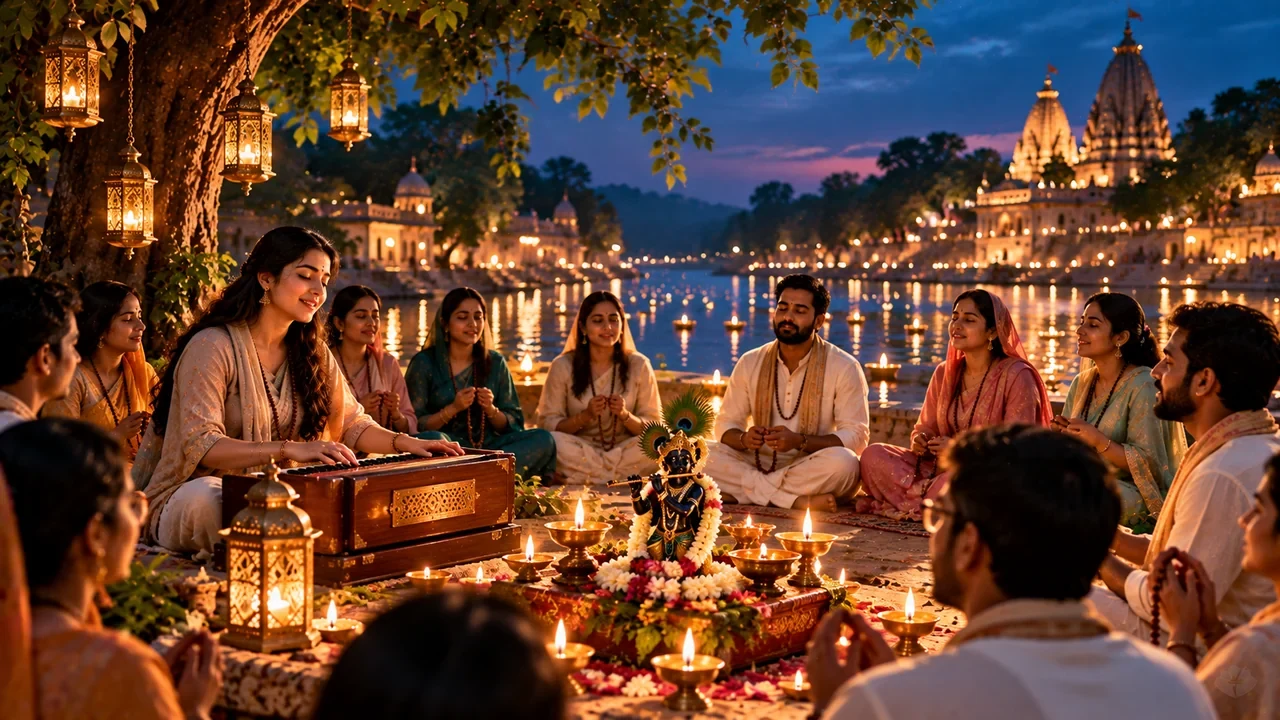
When countless voices remember the Divine with one intention, individual devotion becomes a beautiful expression of collective Bhakti.
When Many Hearts Remember One Divine Name
Imagine hundreds of devotees, living in different cities, following different routines and carrying different responsibilities, yet united by one simple spiritual commitment: remembering Bhagwan.
Some chant early in the morning. Others perform Naam Japa while travelling, during a quiet afternoon or before going to sleep.
They may never meet one another, yet they share a common intention.
This is the beauty of Collective Naam Japa, a spiritual practice in which individual efforts come together through a shared commitment to divine remembrance.
The practice does not necessarily require everyone to sit in the same room or chant at the same time. Even when performed individually, Naam Japa can become part of a collective spiritual initiative.
And when devotees gather to chant together, this shared devotion takes the form of Nama Sankirtana, the congregational singing or chanting of Bhagwan’s divine names.
The Glory of Sankirtana in Kali Yuga
The Srimad Bhagavatam gives special importance to the chanting of divine names in Kali Yuga.
In Srimad Bhagavatam 12.3.51, we find the celebrated verse:
कलेर्दोषनिधे राजन्नस्ति ह्येको महान् गुणः ।
कीर्तनादेव कृष्णस्य मुक्तसङ्गः परं व्रजेत् ॥
Meaning: O King, although Kali Yuga is an ocean of faults, it possesses one great virtue. Through the chanting of Shri Krishna’s divine name, one can become free from material bondage and attain the Supreme.
This teaching offers a remarkable message of hope.
Despite the distractions and difficulties associated with Kali Yuga, divine remembrance remains an accessible path of devotion.
Another significant verse appears in Srimad Bhagavatam 11.5.32, which describes the worship of Bhagwan through Sankirtana Yajna:
यज्ञैः सङ्कीर्तनप्रायैर्यजन्ति हि सुमेधसः ॥
Meaning: Those endowed with spiritual understanding worship through sacrifices consisting principally of Sankirtana.
The complete verse appears in the context of the Bhagavatam’s description of divine worship in Kali Yuga.
Together, these teachings establish the importance of Sankirtana within the Bhagavata devotional tradition.
They also remind us that the remembrance of Bhagwan need not be limited to elaborate external rituals.
Sankirtana Yajna: A Sacred Offering of Divine Names
When we hear the word Yajna, we usually imagine a sacred fire, Vedic mantras and offerings.
But Hindu scriptures also recognize spiritual practices in which devotion itself becomes an offering.
The Bhagavatam’s reference to Sankirtana Yajna presents congregational chanting as a sacred form of worship.
In the Bhagavad Gita 10.25, Shri Krishna declares:
यज्ञानां जपयज्ञोऽस्मि।
Meaning: Among sacrifices, I am Japa Yajna.
Japa and Sankirtana are not identical practices. Japa generally refers to the repeated recitation of a mantra or divine name, often individually, while Sankirtana commonly involves congregational chanting or singing.
Nevertheless, both reflect the importance of sacred sound and divine remembrance within the devotional traditions.
When a person chants with sincerity, the practice becomes an individual offering.
When many devotees join in chanting, their shared devotion can become a collective expression of worship.
The essence is not merely the number of repetitions but the intention with which Bhagwan is remembered.
The Bhagavad Gita: Devotees Inspiring One Another
The Bhagavad Gita contains a beautiful description of devotees who share their spiritual experiences and inspire one another.
In Bhagavad Gita 10.9, Shri Krishna says:
मच्चित्ता मद्गतप्राणा बोधयन्तः परस्परम् ।
कथयन्तश्च मां नित्यं तुष्यन्ति च रमन्ति च ॥
Meaning: With their minds absorbed in Me and their lives devoted to Me, My devotees enlighten one another and constantly speak about Me, finding satisfaction and delight in doing so.
This verse highlights an important dimension of spiritual community.
Devotion is deeply personal, but spiritual companionship can encourage and strengthen it.
A person may sometimes struggle to maintain a daily spiritual routine. Seeing others continue their practices can provide encouragement.
Similarly, sharing scriptural teachings, experiences and reflections can help devotees remain connected with their spiritual purpose.
This is one of the beautiful possibilities of collective spiritual practice: we may practise individually, yet inspire one another collectively.
The Kali-Santarana Upanishad and the Power of Divine Names
The Kali-Santarana Upanishad, a short text associated with the Krishna Yajurveda tradition, emphasizes the chanting of divine names as a means of overcoming the spiritual difficulties of Kali Yuga.
The text presents the sixteen-name Hare Krishna Mahamantra:
हरे राम हरे राम राम राम हरे हरे ।
हरे कृष्ण हरे कृष्ण कृष्ण कृष्ण हरे हरे ॥
The Upanishad praises these sixteen names as a means of crossing beyond the influence of Kali Yuga.
This teaching has been especially influential in traditions centred on the worship of Shri Krishna and Shri Rama.
Across Hindu devotional traditions, devotees also remember Bhagwan through many other sacred names, including Shiva, Narayana, Radha and their chosen Ishta Devata.
The shared principle is divine remembrance through sacred names, even though different traditions may have their own teachings and practices.
Ten Lakh Naam Japa: The Beginning of a Collective Journey
The Sankalp Movement was created around a simple philosophy:
हर सप्ताह एक छोटा आध्यात्मिक संकल्प।
One small spiritual commitment every week.
During the movement’s very first week, participants collectively completed more than 10 lakh Naam Japa, an inspiring beginning to a shared spiritual journey.
What makes this achievement meaningful is not merely the impressive total.
Behind those repetitions were individuals who chose to dedicate a portion of their time to remembering Bhagwan.
Some may have completed larger commitments, while others contributed smaller numbers according to their abilities and circumstances.
Every sincere effort became part of the collective undertaking.
This illustrates an important principle: a large shared achievement can emerge from many small individual commitments.
However, the collective count is best understood as a way to encourage participation and celebrate dedication, not as a measure of anyone’s spiritual superiority or a guarantee of particular spiritual results.
Unity Without Competition
Collective Naam Japa should never become a competition over who chants the most.
Every devotee has different responsibilities, abilities and circumstances.
One person may be able to complete 10,000 repetitions, while another may manage only 108.
The purpose of a collective Sankalp is to encourage everyone to participate sincerely, without comparison or pressure.
In Bhagavad Gita 9.26, Shri Krishna teaches that He accepts even a leaf, flower, fruit or water when offered with devotion.
The verse concerns devotional offerings, but it also reminds us of the central importance of Bhakti.
A modest spiritual commitment undertaken with sincerity should not be dismissed simply because another person’s effort appears greater.
In a genuine spiritual community, one person’s progress becomes a source of encouragement rather than comparison.
A Community Connected Through Devotion
Modern technology allows spiritual communities to remain connected even when members live far apart.
A WhatsApp group, an online Satsang or a weekly spiritual gathering can become a place where devotees encourage one another to practise Naam Japa, read scriptures and undertake acts of Seva.
Technology itself does not create devotion, but it can provide a convenient means of supporting spiritual discipline and companionship.
Within the Sankalp Movement, each weekly commitment offers participants an opportunity to dedicate time to spiritual growth.
Some Sankalps may involve Naam Japa, while others may encourage Ann Daan, lighting a diya, compassion towards living beings or other meaningful practices.
The intention is to gradually make spirituality a living part of everyday life.
One Name, Many Voices, One Beautiful Intention
The spiritual significance of Naam Japa is not confined to extraordinary occasions.
It can begin quietly, with one person, one divine name and a few moments of sincere remembrance.
When many individuals adopt this practice, they create a community connected by a shared spiritual aspiration.
The Srimad Bhagavatam glorifies Sankirtana, while the Bhagavad Gita celebrates devotees who remember Bhagwan and inspire one another.
Together, these teachings offer a beautiful foundation for collective devotion.
One person may chant a divine name. A thousand people may chant the same name. What unites them is not merely the sound, but their shared remembrance of Bhagwan.
Through the Sankalp Movement, every participant has an opportunity to contribute to this journey.
One small commitment may appear insignificant on its own, but when practised with sincerity and joined by the efforts of others, it can become part of something deeply meaningful.
Many hearts. Many prayers. One shared journey towards the Divine.
Sambhasha | Divine Dialogues
Scriptural References
- Srimad Bhagavatam 12.3.51: The significance of Krishna Kirtan in Kali Yuga.
- Srimad Bhagavatam 11.5.32: Worship through Sankirtana Yajna.
- Bhagavad Gita 10.25: Shri Krishna’s identification with Japa Yajna.
- Bhagavad Gita 10.9: Devotees inspiring one another through divine remembrance and spiritual discussion.
- Kali-Santarana Upanishad: The sixteen-name Mahamantra and its significance in Kali Yuga.
- Bhagavad Gita 9.26: The importance of devotion in making offerings to Bhagwan.
Note: Congregational Sankirtana and individually performed Naam Japa contributed towards a shared numerical total are related but distinct forms of collective devotional participation. The latter is a contemporary organizational practice, not a specific ritual prescribed by the cited verses.